One of Christendom’s “lost realities” is the conviction that humanity stands in a totally unique category of being, separated from all other forms of life as the “image of God” (imago Dei in Latin; ikon Theou in Greek). This theological conviction long governed the way the West looked on itself and the rest of the world. But in the nineteenth century, as modern biology displaced theology, a rival assertion about human being appeared. The new conviction was that man was simply an animal deserving a taxonomy like any other animal. Accordingly, he is not imago Dei but Homo sapiens. And though he might be superior to the earth’s other animals, he is, in the end, only an animal. This conviction marked the West’s greatest anthropological revolution since Pentecost.
Continue readingAmerica’s Ironic Attachment to a Piece of Russian Music
Americans love national celebrations. All nations do. In our case, the most popular is of course the anniversary of the Declaration of Independence on July 4. It not only marks our political freedom from Great Britain but also serves as a celebration of our unlikely victory in the war that followed.

What most Americans do not realize, however, is how dependent we are on other nations in celebrating our independence.
Continue readingVolume Three
Much time has again passed since my last post. Much of it was spent completing the third volume of my book series, The Age of Utopia: Christendom from the Renaissance to the Russian Revolution. 
A brief description of it can be found under the Books tab on this website, and it can be ordered online through Amazon here.
Age of Utopia has actually been out for the better part of a year. Since its appearance, I have been busy writing the final volume of Paradise and Utopia, entitled The Age of Nihilism: Christendom from the Great War to the Culture Wars. I will offer updates on that as its release approaches in a month or two.
The Specter of Anthropological Pessimism
In my presentation of past articles on the origin of what I call the “age of utopia”–the story of which I’ve been writing in recent months–this one helps establish the context in which the “father of humanism,” Francesco Petrarch, made his breakthrough into modernity. In a real sense it was a reaction against a pessimism that had never sat well within Christendom.

What historians call the late middle ages was a difficult period in the history of western Christendom. From about 1300 to about 1500, a series of horrible events occurred including the Black Death and the Hundred Years War.
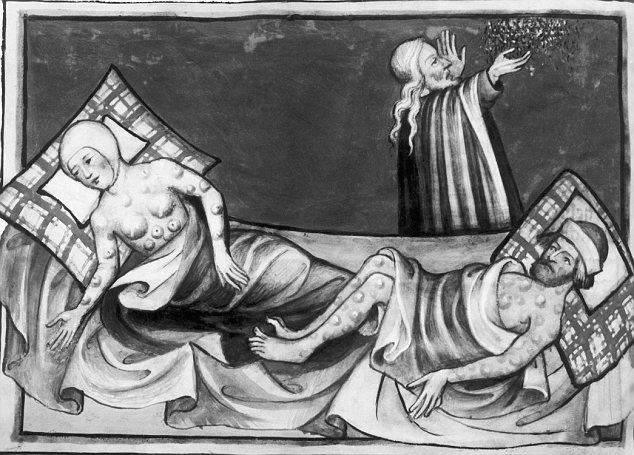 Dying Victims of Black Death
As they did, they caused new features of western culture to appear. Or perhaps it is more accurate to say that these catastrophes acted as abrasives across the surface of an otherwise verdant Christian culture, exposing stones that had long remained buried beneath it.
One of these long buried stones was what can be called anthropological pessimism, a emphatically negative view of the human condition in this world.
View original post 930 more words
Why Hesychasm Mattered
This repost from several years ago discusses one of the essential differences between the old Christendom of the East and the new Christendom born of the Papal Reformation. That difference is hesychasm, and it can be seen in the iconography that was abandoned when the new Christendom turned to naturalistic painting during the Renaissance.
In yesterday’s post I presented the movement in fourteenth-century eastern Christendom known as hesychasm as a sort of foil (or contrasting device) against the disaffection that was stirring at the time among western thinkers such as Petrarch. The necessary link in this case was Barlaam of Calabria, the theologian who lived temporarily in Byzantium but fell out with the hesychastic current there and ultimately returned to his native Italy. There he converted to Roman Catholicism. Serving as Greek tutor to the illustrious Petrarch, it is conceivable that his agnosticism about the possibility of man experiencing the immediate presence of God in this world (what I call “paradise”) was passed on to his pupil, soon to be known as the father of modern humanism.
And so, we not only have a moment when a new stage in the history of Christendom is discernable–what I called the symbolical birth of utopia–but also…
View original post 929 more words
The Birth of Utopia
Having released volume two in my history of the rise and fall of what the West once was, I have been writing the first chapters of its sequel. Since this blog is designed to share the ideas that go into this next volume (as well as the one that follows), I will be reposting some of my earlier posts in the weeks ahead. The one I am presenting today tells the interesting but little known story of a philosopher named Barlaam and his impact on the “father of humanism,” Francesco Petrarch.
It has been several months now since my last post, and I apologize to my readers for the long delay. It is due in part to obligations and tasks that arose soon after Christmas and which required my attention. It is also due to the fact that in presenting my reflections I came to a point that required a pause as I prepared for a new phase in the project. This post represents the beginning of that new phase, as I take a step back in time from from what for the most part has so far been reflections on the twentieth century. Modern Christendom, the subject of this blog, is after all the result or product of cultural shifts occurring over a period much greater than the few generations that separate us from the rise of things like militant atheism.
So far I have been interested mainly in recent history…
View original post 784 more words
On the Diminution of Angels
The reorientation of modern Christendom toward an untransfigured world was, as I indicated in in another post, the central project of the Renaissance. This Renaissance project was inspired by the values of the classical pagan world, but it was also motivated more immediately by the desire to escape the increasingly pessimistic anthropology of medieval western Christendom. Humanists like Mirandola proclaimed a new humanity to their generation, one that possessed free will, one that enjoyed complete autonomy. This was the dream of the Renaissance, and it became over the centuries an inalienable feature of our modern culture. Continue reading
The Old Christendom Enters a New Millennium
In two weeks, Orthodox Christians throughout what was once the Soviet Union will be celebrating the memory of the New Martyrs and Confessors of that land (those following the Western calendar in America and elsewhere celebrated the event yesterday). These people were killed for their faith between the Bolshevik Revolution in 1917 and the collapse of Communism in 1991. Recognized as saints since 1982 by the Russian Orthodox Church outside of Russia, they were eventually canonized in Russia by the Patriarchate of Moscow in 2000. That event itself was a symbolical milestone in the history of Christendom, for it represented the restoration of traditional Christianity to a place of vitality within our culture. Continue reading
The Measure of All Insurrections
On October 25, 1917, an insurrection took place that must surely stand as one of the most momentous domestic attacks on government in history. Known as the Bolshevik Revolution, it set the standard of what an insurrection is and should by definition be.
The Age of Division
The Age of Division, volume two of my history of Christendom, has now been released by Ancient Faith Publishing.
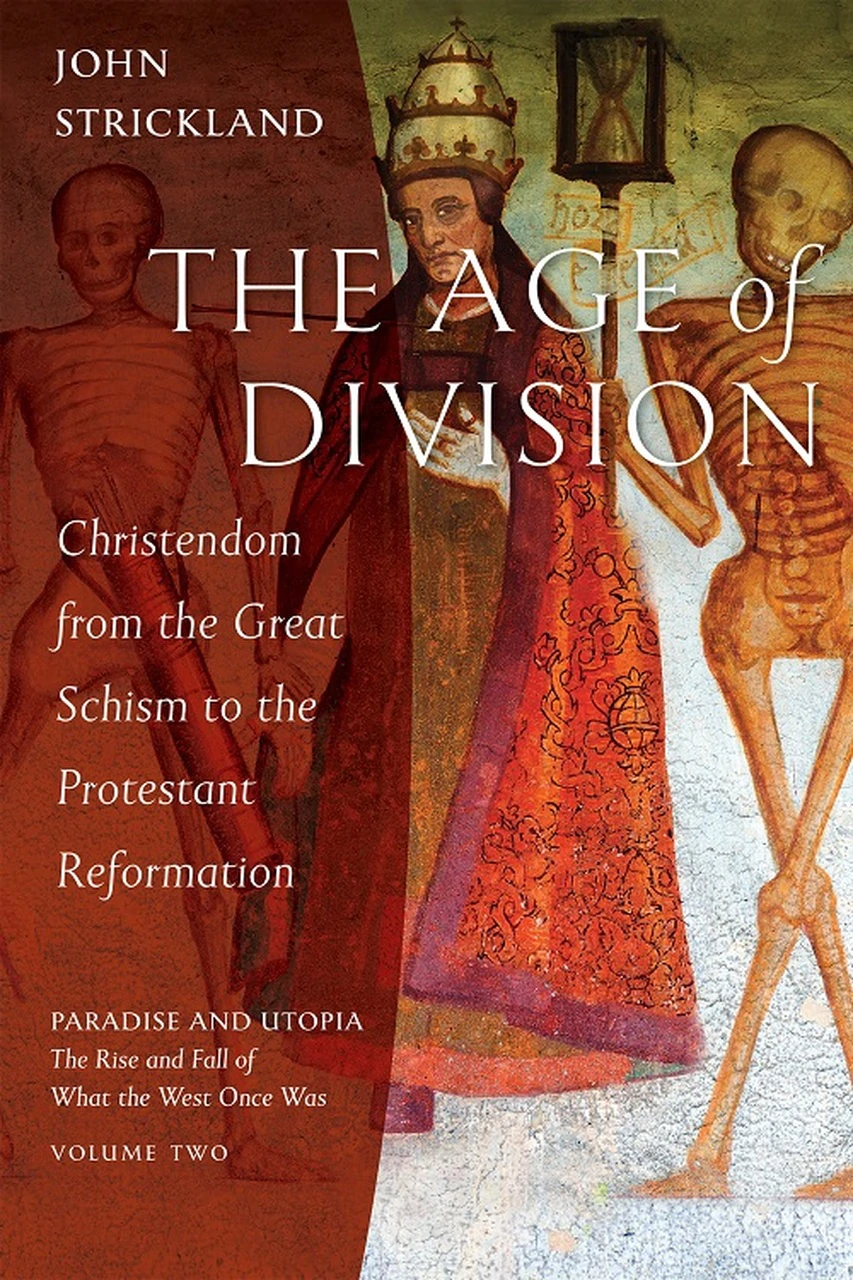 Building on The Age of Paradise, it carries the story of the rise and fall of what the West once was beyond the first millennium. Opening with events surrounding the fateful Great Schism of 1054, it follows efforts by the papacy to impose a thorough-going reform of Western Christendom. In addition to improving the spiritual quality of church life, the Papal Reformation also unleashed other forces including the crusades and, more indirectly but tragically, a penitential piety that slowly eroded the place of paradise within Western culture.
The book also tells the story of Eastern Christendom during this period, when the Fourth Crusade and the Turkish onslaught finally brought Constantinople to its knees. Nevertheless, in Russia the Orthodox Church continued to nurture the culture of the old Christendom, despite growing isolation from the West and the depredations of Ivan the Terrible.
The Age of Division concludes with a reflection on the sixteenth-century Protestant Reformation, which both continued the process of transformation begun by the papacy in the eleventh century and, in very significant ways, brought it to an end.
For those interested in obtaining a copy, the book can be found at the Ancient Faith Store and Amazon.
 PARADISE AND UTOPIA