A Final Lullaby for Hitler

Soviet-soldiers-attack-down-a-Berlin-street.-Photograph-321-Russian-State-Archives.1

April, 1945 was not a good month for Hitler or the German nation he ruled. The Third Reich teetered on the brink of collapse and a national catastrophe loomed. As American soldiers fought their way across the Rhine River from the west, the Russians moved inexorably toward a doomed Berlin from the east. Soon the city Hitler had once dreamed of redesigning as a monument to Nazism would be reduced to rubble by the Red Army. Mere boys were conscripted to mount a hopeless defense and young women prepared for the worst at the hands of the approaching conquerors. The atmosphere was simply apocalyptic. And it was in exactly this atmosphere that a symbolic but unnoticed moment in the history of modern Christendom was played out.

Albert Speer, the evil genius of German wartime munitions production and a professional architect–indeed, the very man Hitler chose to give Berlin its modernistic face lift–organized one final, climatic performance of the city’s world-famous philharmonic. The event must have been surreal. He tells of it in his remarkable memoirs, Inside the Third Reich.  I always find myself fascinated by this work, written as it was by a man who looked over Hitler’s shoulder at some of the most important scenes in the history of Nazi Germany (he can be seen immediately to the Fuehrer’s right in the famous photograph taken before the Eiffel Tower after the fall of France).

The musical performance Speer organized as the capital was encircled served as a kind of artistic last will and testament of National Socialism. As such, it provided a kind of swan song or perhaps even final lullaby for the visionary Fuehrer who had now withdrawn underground into his bunker to prepare for the end, brooding over plans to kill himself.

What was Speer’s musical taste for such an occasion? What else could it be? Richard Wagner’s opera Goetterdaemmerung, or Twilight of the Gods. Wagner was, of course, the preeminent composer for Hitler, and the final opera in the series the Ring of the Nibelung contained an ending that was as nihilistic as Hitler’s vision of the world. I will have much to say about Wagner’s place in the history of Christendom in later posts. It is really quite significant. For the moment, it is striking how well the music suited that vision.

In the final scene of the work, the heroine Brunnhilde, who is herself preparing to commit suicide by riding atop the funeral pyre of her lover Siegfried, pauses for a moment to sing softly to her absent father, the impotent god Wotan. In fact she sounds more like a mother singing a bedtime lullaby to her child. “Ruhe, ruhe, du Gott!” she coos, “rest, rest, O god!” And then the ten-minute march toward the destruction of everything begins, as the Rhine River overflows and the palace of the gods, Valhalla, comes crashing down in flames. It is marvelous music, beautiful and stirring and, when put to use by the Nazis, chilling. If any of my readers has never experienced it, one particular good production (with Gwyneth Jones singing the lead) can be watched here. As the smoke rises on stage at the end of the  performance, the scene looks rather like what I expect Berlin did after its fall in 1945. 

“Rest, rest, O god!” These words say quite a bit about modern Christendom. No longer convinced that a heavenly paradise can be attained in this world, no longer hopeful that a secular utopia can be built in its place, the values of twentieth-century Christendom found it difficult to resist nihilism. And in the case of the Nazis, to a horrendous degree.

And what was it like to attend that final concert in the doomed Nazi capital? One account related that when it was over, and the chords of one of modern Germany’s greatest musical compositions gave way to the distant thud of approaching tanks, a Nazi official was standing by to distribute cyanide tablets to Berlin’s true believers as they departed.

Was such a scene inevitable for a culture that had lost its moorings in both paradise and utopia?

“One Nation under God”

UnderGod01  It has been a decade since the Ninth Circuit Court sought to ban the use of the phrase “one nation under God” in the Pledge of Allegiance, sparking a brief but violent firefight in the culture wars that mark American politics today. Though prominent Democrats as well as Republicans denounced the decision–soon nullified by the Supreme Court’s intervention on technical grounds–many wondered if it was a sign that American Christendom was reaching the end of its history.

In a fascinating new book, Princeton historian Kevin Kruse explores the origins of the famous phrase contained within the Pledge of Allegiance, as well as other religiously charged phrases and ceremonies at the heart of modern American politics. One Nation under God: How Corporate America Invented Christian America (Basic Books, 2015) is a provocative account of religious rhetoric in American political life. Kruse argues that the Pledge’s famous “under God” clause represents an invented tradition, and one of very recent provenance during the aftermath of the Second World War.

As a study of what Kruse calls “religious nationalism,” the book is of great interest to any one trying to make sense of the role played by Christianity in the modern state. For this reason, I found it to be a fascinating parallel to my book The Making of Holy Russia: The Orthodox Church and Russian Nationalism before the Revolution.  There I argued that the religious nationalism of many modern Russians–most recently Vladimir Putin himself– was in fact a rather new historical phenomenon. But whereas I located it in the missionary activities of Christian leaders, Kruse in the case of America sees big business and political conservatives as the source.  In any event, the role of religion in modern political life–Russian as well as American–can not be ignored.

The conviction that America is fundamentally a Christian nation whose identity rests on the twin pillars of religious freedom and political liberty has long characterized political rhetoric, becoming in recent decades more and more a monopoly of the right. Kruse reveals that expressions of it such as “one nation under God” and “in God we trust” are indeed recent, at least in official usage. A large part of his narrative documents the formal approval of these phrases by Congress during the 1950s, a time when America was struggling to define herself in opposition to the Soviet Union. America was defined in that heady context as not atheistic, and as a result political leaders on both sides of the aisle were compelled to emphasize her religious heritage. 

The history of the Pledge is particularly interesting within this narrative. Readers learn how the original form of the Pledge–predating the Cold War–lacked the “under God” clause and how it was drafted by a self-proclaimed Christian socialist and nephew of the famous radical Edward Bellamy, who attacked nineteenth-century American capitalism in the famous utopian novel Looking Backward. This is deeply ironic for Kruse, as the Pledge would ultimately come to be used as a weapon in the hands of big business and the political right.

What is perhaps most interesting in this book is the debate about American Christendom that surrounds it. Not only does the author engage the question of the origins and character of America’s “religious nationalism,” he is shaped and perhaps even reacting to it himself. My guess is that he does not regard it very favorably. But like it or not, he does reveal that the end of American Christendom is still a long way off.

← Back

Thank you for your response. ✨

Warning
Warning
Warning
Warning

Warning.

So What’s with the Women?

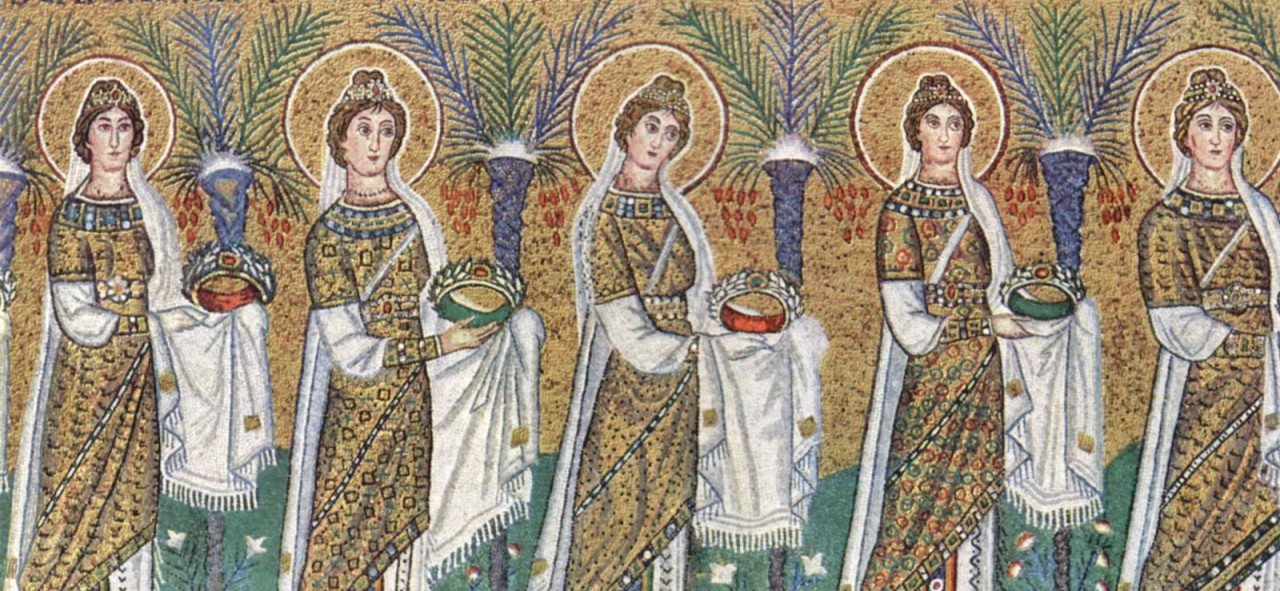
This blog is about the history of Christendom, so what’s with the curious-looking women in the header’s image?

Well, these are very special women and they have a great deal to say about the content of my blog. They adorn one of the most famous temples in Christendom, and one that brings both its eastern and the western halves together in a common experience of paradise. It is the Basilica of Saint Appolinare the New in Ravenna, Italy. Listeners of my podcast already know of its importance in the history of western civilization’s architecture and painting. (If you haven’t listened to that episode, you can do so here). It was built in the sixth century by the western Ostrogoth King Theodoric the Great but consecrated in the time of eastern Byzantine Emperor Justinian (who proved to be even greater).

These women are also noteworthy because they are, after all, women. Christendom transformed ancient society’s attitudes toward women, elevating them according to traditional Christianity’s standards of sexual dignity and the value of the human person, female as well as male. (You can listen to my podcast on this topic here).Sharing equally in “the image of God”–that essential feature of the traditional Christian vision of humanity–they are depicted here standing equal to and not behind a matching image of men on the wall opposite to them. They hold crowns of glory in their hands.

But most importantly, the image I chose for the blog’s header features one of the most explicit statements about the core experience of Christendom. These women have a purpose. They are going somewhere. What is their destination? The iconographer who depicted them, by integrating his work with the very architecture of the temple, subtly directed their bodies toward the altar area at the easternmost part of the building (to the right of the image we see). The women are therefore oriented, which literally means “facing east.” That is their destination. And not just that, but facing east and moving in its direction they are experiencing paradise, because according to traditional Christianity (and Judaism) paradise is planted in the east (Gen. 2:8). Living in this world, they belong to the kingdom of heaven which is not of this world but which has broken into it and is already present within it. They live in paradise.

This is the core experience of Christendom.

Welcome to My Website!

cropped-bisanzio43.jpg Hello, and welcome to my website! My name is John Strickland and I have been in love with the past since first learning about it in books littering my father’s bookshelves while growing up in California. I now live with my wife and five children in beautiful Puget Sound, where I am the pastor of an Orthodox Church in the town of Poulsbo, amid the serene fjords and forested mountains that surround a place called Liberty Bay. I am also the author of a book entitled The Making of Holy Russia and have been teaching college for a couple of decades.

My next book is about the history of Christian civilization, or Christendom, and this blog is designed to give me a chance to research and develop ideas for it and share them with you, my potential future readers. It is entitled Paradise and Utopia for reasons that will be clear as you read through my posts, but if you would like a head start you can read the page entitled “What is Christendom?” off of the main page. You should also know that I have a podcast by the same name and you can visit it to listen to more in-depth presentations and lectures on the topics I raise here.

I will try to post new articles on this blog each week, and if you enjoy them please leave a comment, or (even better) subscribe to it! And if you wish to contact me, I can be reached through the contact form off of the main page.